

 |
This book is a basic introduction to the brain mechanisms of perception. It is meant to be easy reading for those new to the field, especially first year students of Psychology, Biology, or Computer Science. More information about the book is available at Fischer Taschenbuch Verlag, where the book can be ordered. You can also order from Amazon. |
|
A comparison
of pursuit eye movement and perceptual performance in speed
discrimination |
 |
Neuronal
processing delays are compensated in the sensorimotor branch of the
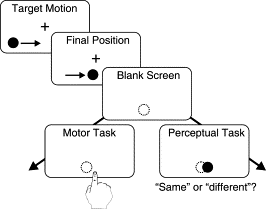
visual system. Kerzel, D. & Gegenfurtner, K. R. Curr. Biol. 13, 1975–1978 (2003) <Get PDF file> Moving objects change their position until signals from the photoreceptors arrive in the visual cortex. Nonetheless, motor responses to moving objects are accurate and do not lag behind the real-world position. The questions are how and where neural delays are compensated for. It was suggested that compensation is achieved within the visual system by extrapolating the position of moving objects. A visual illusion supports this idea: when a briefly flashed object is presented in the same position as a moving object, it appears to lag behind. However, moving objects do not appear ahead of their final or reversal points. We investigated a situation where participants localized the final position of a moving stimulus. Visual perception and short-term memory of the final target position were accurate, but reaching movements were directed toward future positions of the target beyond the vanishing point. Our results show that neuronal latencies are not compensated for at early stages of visual processing, but at a late stage when retinotopic information is transformed into egocentric space used for motor responses. The sensorimotor system extrapolates the position of moving targets to allow for precise localization of moving targets despite neuronal latencies. See also note in Nature Reviews Neuroscience |
 |
The perception of colour is a central
component of primate vision. Colour facilitates object perception and
recognition, and has an important role in scene segmentation and
visual memory. Moreover, it provides an aesthetic component to visual
experiences that is fundamental to our perception of the world.
Despite the long history of colour vision studies, much has still to
be learned about the physiological basis of colour perception. Recent
advances in our understanding of the early processing in the retina
and thalamus have enabled us to take a fresh look at cortical
processing
of colour. These studies are beginning to indicate that colour is
processed not in isolation, but together with information about
luminance and visual form, by the same neural circuits, to achieve a
unitary and robust representation of the visual world. Gegenfurtner, |
 |
Gegenfurtner, K.R. & Sharpe, L.T. (1999) Color vision: from genes to perception.
New York: Cambrdge University Press.
A collection of review articles ranging from photoreceptors to retinal and cortical circuitry all the way to perception. Order from Cambridge University Press (US or UK) or from Amazon (US, UK, DE). <Get PDF file
for Chapter 1> |
 |
Gegenfurtner, K.R. & Rieger, J. (2000) Sensory
and cognitive contributions of color to the perception of natural scenes.Current
Biology, 10, 805-808.
<Get PDF file>
|
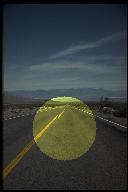 |
Gegenfurtner, K.R., Mayser, H. & Sharpe, L.T. (1999) Seeing
movement in the dark. Nature, 398, 475-476.
<Get PDF
file> |
 |
Rüttiger, L., Braun, D.I., Gegenfurtner, K.R., Petersen,
D., Schönle, P. & Sharpe, L.T. (1999) Selective
colour constancy deficits after unlilateral brain lesions. Journal
of Neuroscience, 19, 3094-3106.
<Get PDF
file> |
