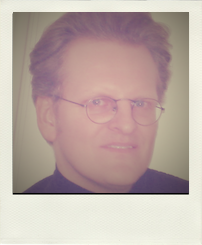
Dr. Thorsten Hansen
Abteilung Allgemeine Psychologie
Justus-Liebig-Universität Gießen
Alter Steinbacher Weg 38
35394 Gießen
Deutschland
Campus: Phil 1, GCSC building, Alter Steinbacher Weg 38, Room 101
Email: Thorsten.Hansen@psychol.uni-giessen.de
Phone: +49 641 9926131
Fax: +49 641 9926119
|
|
I am interested in human vision, in particular color vision. We use psychophysics, computational modeling, and natural scene statistics to understand the principles that govern the representation and the processing of color and form.

[CV]
[Publications]
[Talks]
[Teaching]
[Research]
[Awards]
|
2002 Ph.D. in Computer Science (Dr. rer. nat.), University of
Ulm, Germany
1997 Diploma in Computer Science, »mit Auszeichnung«, Technical University of Braunschweig, Germany
|

Journal Articles (29) 
8) Sharpe, L. T., De Luca, E., Hansen, T., Jägle, H., & Gegenfurtner, K. R. (2006).
Advantages and disadvantages of human dichromacy.
Journal
of Vision,
6(3), 213–223.
[www.journalofvision.org]
Book Chapters (11)
11) Witzel, C., & Hansen, T. (2015). Memory effects on colour perception.
In A. J. Elliot & M. D. Fairchild (Eds.) Handbook of color psychology (pp. 641–665).
Cambridge, UK: Cambridge University Press.
10) Hansen, T., & Gegenfurtner, K. R. (2013).
Stichwortartikel zu Farbwahrnehmung. Kardinale Farbmechanismen. Kortikale Farbmechanismen. Okzipitalkortex. Photorezeptoren.
In M. Wirtz (Ed.) Dorsch – Psychologisches Wörterbuch – Gebiet Allgemeine Psychologie: Kognition.
9) Olkkonen, M., Hansen, T., & Gegenfurtner, K. R. (2012). High level perceptual influences on color appearance.
In G. Hatfield & S. Allred (Eds.), Visual Experience: Sensation, Cognition, and Constancy (ch. 9, pp. 179–198). Oxford, MA: Oxford University Press.
8) Hansen, T. (2010).
Color naming.
In E. Bruce Goldstein (Ed.),
SAGE Encyclopedia of Perception (pp. 265–266).
Thousand Oaks: SAGE.
7) Hansen, T. & Gegenfurtner, K. R. (2007).
Color processing.
In U. Windhorst, M. Binder, & H. Hirokawa (Eds.),
Springer Encyclopedia of Neuroscience.
Heidelberg: Springer-Verlag.
© Springer-Verlag.
6) Hansen, T., & Gegenfurtner, K. R. (2007).
Higher order color mechanisms for image segmentation.
In F. Mele, G. Ramella, S. Santillo, & F. Ventriglia (Eds.),
Brain, Vision and Artificial
Intelligence 2007
. LNCS/LNAI. Heidelberg: Springer-Verlag.
© Springer-Verlag.
5) Hansen, T., & Gegenfurtner, K. R. (2007). Farbwahrnehmung. In J.
Steinbrenner & S. Glasauer (Eds.), Farben – Betrachtungen aus Philosophie und Naturwissenschaften (pp.
277–291). Frankfurt am Main: Suhrkamp.
4) Gegenfurtner, K. R. & Hansen, T. (2006). Farbwahrnehmung –
Color Vision. In J. Funke & P. A. Frensch, (Eds.), Handbuch der Allgemeinen Psychologie – Kognition. Göttingen: Hogrefe.
Selected Conference Papers
Hansen, T. (2012).
The contribution of color to edge detection natural scenes.
Centre de Visió per Computator (Color Vision Center), Universitat Autònoma de Barcelona, Barcelona, Catalonia, Spain. Nov. 20, 2012.
Hansen, T. (2011).
The contribution of color to detecting edges in natural scenes.
Computational Color Imaging Workshop, CCIW 2011, University of Milano-Bicocca, Italy. Apr. 20, 2011.
Hansen, T. (2010).
Multiple mechanisms in higher order color processing.
Institute for Basic
Psychological Research, Faculty of Psychology, University of Vienna. Jan. 19, 2010.
Hansen, T. (2008).
Color perception.
Institute for Basic
Psychological Research, Faculty of Psychology, University of Munster, Germany. Nov. 2008.
Hansen, T. (2008).
Chromatic discrimination.
Visual
Perception Lab, Department of Psychology, Christian-Albrechts-University Kiel, Germany. Nov. 2008.
Hansen, T. (2007).
Higher order color processing.
Honda Research Institute Europe, Offenbach/Main, Germany. Oct. 16,
2007.
Hansen, T. (2007).
Wie unser Gedächtnis die Farbwahrnehmung beeinflußt.
Farbinfo 2007, Stuttgart, Germany. Sep. 28, 2007.
Hansen, T. (2007).
Chromatic discrimination of synthetic and natural textures.
British Colour Group Vision meeting, Institute of Ophthalmology,
London, UK. Jan. 10,
2007.
Hansen, T. (2004).
A neural model of early visual processing utilizing recurrent
long-range interactions.
TeaP 2004, Giessen, Germany. Apr. 6, 2004.
Color Vision
We combine psychophysical methods, computational modeling and natural scene statistics
to investigate the principles of early and higher order mechanisms of color processing.
|
|
The number and nature of higher order color mechanisms
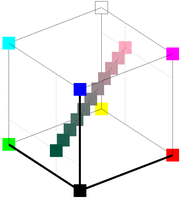
Color vision begins in the retina with three different type of photoreceptors. These responses are combined already in the retina to form three different channels. These early retinal stages are well understood. The further processing of the color signal in the cortex is less well understood. Physiologists have measured what color a neuron prefers, i.e., to which it responds best. In the primary visual cortex, the first stage of cortical processing, the color preferences span the full color circle. In psychophysical studies we complement these physiologicial findings and show that the detection of color is mediated by many mechanisms. However, other researchers have found only a few mechanims. How does this discrepancy occur? In our recent work we have shown that those who found few mechanisms have used an suboptimal set of stimuli to probe the full range of mechanisms.
|
|
Neural Models in Early Vision
The research covers a broad range of processing mechanisms in early
vision, motivated by empirical findings and computational considerations:
- contrast and edge detection
- contour detection and grouping
- corner and junction detection
- surface perception
These topics have been examined as part of my Ph. D. thesis supervised
by
Heiko Neumann.
|

|
  |
The paper A Neural
Model of Dominating Opponent Inhibition in Visual On and Off Pathways
for Robust Contour Extraction has been awarded the
`KI/Kognitionspreis' for the best contribution of a young scientist in
the field `Kognitionswissenschaftliche KI', assigned by the
`Gesellschaft für Kognitionswissenschaft' and the `Fachbereich 1 der
Gesellschaft für Informatik' at the `Fachtagung der Gesellschaft für Kognitionswissenschaft', KogWis, 1999. |
  |
Postdoctoral fellow travel fellowship. 7th International conference on
cognitive and neural systems ICCNS 2003, Boston, MA.
Graduate student travel fellowship. 6th International conference on
cognitive and neural systems ICCNS 2002, Boston, MA.
|
Foundations
- Deutsche Forschungsgemeinschaft (DFG)
Journals
- Biological Cybernetics
- IEEE Intelligent Systems
- International Journal on Pattern Recognition and Artificial Intelligence
- Journal of Experimental Child Psychology
- Journal of the Optical Society of America A
- Journal of Vision
- Memory & Cognition
- Network: Computation in Neural Systems
- Neural Networks
- Optics Express
- Ophthalmic and Physiological Optics
- Perception
- Physica D: Nonlinear Phenomena
- Vision Research
- Visual Neuroscience
Ph. D. Theses
- Jens Christiansen (2007). Color appearance during binocular
rivalry and permanent suppression. Department of
Psychology, University of Copenhagen, Denmark.
Session Chair "Visuelle Wahrnehmung", TeaP 2007, Trier, Germany.
Session Chair of the Symposium "Color Vision", TeaP 2006.
Symposium organized together with Karl R. Gegenfurtner.
Hansen. T., & Hamburger, K. (2007). Geometrical optical
illusions at isoluminance. Demo night, Vision Sciences Society 7th
Annual meeting VSS 2007, Sarasota, FL.
Hansen. T., Hamburger, K., Gegenfurtner, K. R. (2005). Bouncing
Brains. Top Ten Finalist, Third Annual Best Visual Illusion of the
Year Contest, Sarasota, FL. You can even buy a T-shirt
with this illusion.
Hansen. T. (2005). Modified Munker-White illusion. Top Ten
Achromatic illusion, First Best Illusion of the Year Contest.
Exhibition "Illusiones visuales" at the Science Museums of A Coruña "Casa de las ciencias", July-August 2005. A Coruña, Spain.
Dr. Thorsten Hansen |
Both diagonals have the same color:
move your mouse to the image!
You may also want to check out the Bouncing Brains.
|
 © Thorsten Hansen
|
Hansen. T.(2005). TransQ — Temporal modulation of chromatic
noise processes with a natural amplitude spectrum. Demo night, Vision
Sciences Society Fifth Annual meeting (VSS 2005), Sarasota, FL.
Stud.IP
Lectures
SS 2004
Vorlesung Sinnesphysiologie und Wahrnehmung:
Two lectures on color vision (in German)
Farbwahrnehmung I
Farbwahrnehmung II
Seminars
WS 2009/2010
Seminar
(Visuelle) Wahrnehmung
SS 2005 - SS 2008
Blockkurs Psychophysische Methoden und Matlab Programmierung
SS 2006
Computer Exercises Matlab, Psychtoolbox, Color image processing, Motion at the
European Summer School "Visual Neuroscience &mdash from Spikes to Awareness",
Sep. 6–17, 2006. Organized by Frank Bremmer, Jochen Braun and Karl R.
Gegenfurtner at Rauischolzhausen Castle, Germany.
SS 2005
Blockkurs Psychophysik
WS 2004/2005
Seminar Visuelle Wahrnehmung
Seminar Farbwahrnehmung
SS 2004
Seminar Farbwahrnehmung
SS 2004
Blockkurs Psychophysische Methoden
im
Graduiertenkolleg Neuronale Repräsentation und Handlungssteuerung NeuroAct
SS 2004: Computer Exercise Color Image Processing at the
European Summer School "Visual Neuroscience-from Spikes to Awareness",
Sep. 6–17, 2004. Organized by Frank Bremmer, Jochen Braun and Karl R.
Gegenfurtner at Rauischolzhausen Castle, Germany.
SS 2003 Seminar: Methoden der Psychophysik
■ Ph. D. Theses (together with Prof. Dr. Karl R. Gegenfurtner)
Martin
Giesel (2009). Chromatic discrimination of complex stimuli.
Maria
Olkkonen (2009). Investigating the mechanisms of
real-world color constancy.
Kai
Hamburger (2007). Visual illusions: Perception of
luminance, color, and motion in humans.
Lars Pracejus
(2007). Defective color vision (Wahrnehmungsdefizite bei
zentralen neurologischen Erkrankungen &ndash Farbwahrnehmung auf
retinaler und zerebraler Ebene).
Sebastian Walter. Color constancy, color categorization, aesthetic color-form preferences, lens brunescense.
Christoph
Witzel. Color, categories and memory.
■ Diploma Theses
Florian Bayer (2009). A biologically-inspired neural
network for motion detection &ndash modelling and psychophysics.
Abteilung Allgemeine Psychologie der
Justus-Liebig-Universität Gießen.
Stefanie Weis (2009). Einfluss von Farbe auf die Steuerung von
Aufmerksamkeit und Blickbewegungen bei abstrakten Bildern und
Werbeplakaten. Abteilung Allgemeine Psychologie der
Justus-Liebig-Universität Gießen.
Lukas Kaim (2006). Interaktive Simulation einer parvozellulären retinalen Ganglienzelle. Fachbereich Informatik der Fachhochschule Gießen-Friedberg und Abteilung Allgemeine Psychologie der Justus-Liebig-Universität Gießen.
■ Bachelor Theses
Arkadius Gotz (2010). Einfluss von lokalem Kontrast und Beleuchtungsfarbe auf die Farbkonstanz.
Abteilung Allgemeine Psychologie, Justus-Liebig-Universität Gießen.
David Weiß (2010). Einfluss von 2D und 3D Hinweisreizen und verschiedenfarbigen Beleuchtungen auf die Farbkonstanz.
Abteilung Allgemeine Psychologie, Justus-Liebig-Universität Gießen.
■ Undergraduate Projects (Semesterarbeiten)
Laura Fietze (2007). Frauen können Rottöne besser unterscheiden?
— Untersuchung geschlechterspezifischer Unterschiede in
der chromatischen Diskrimination
Martin Krebber (2007). Können Grüntöne besser unterschieden
werden als Rottöne?
— Untersuchung farbtonspezifischer Unterschiede in der chromatischen Diskrimination
Franziska Stephanie Urban (2006). Raumzeitliche
Klassifikationsbilder zur Untersuchung chromatischer
Signalentdeckung
Mario Dirks (2005). Einfluß der Gedächnisfarbe auf die Farbwahrnehmung. Received the second poster award at the annual faculty students' poster presentation.
Andrea Fuchs (2005). Farbkategorisierung von natürlichen Objekten.
Anke Haberkamp (2005). Geometrisch-optische Täuschungen
unter Isoluminanz.
Judith Kowalsky (2005). Die Untersuchung
möglicher Korrespondenzen zwischen Grundfarben und Grundformen.
Filipp Schmidt (2005). Farbdiskriminierung bei natürlichen Objekten.
Daniel Drescher (2004). Objektbezogenen Farbdiskriminierung.
Links
Visitors since February 16th, 2015